Soph’s Story
When Ellen was pregnant with her second child, she already knew something wasn’t right. Yet, from the very beginning, her daughter Soph has defied expectations.
“When I was pregnant with Soph, we found out she had a heart issue and that she would need surgery very, very quickly. What we didn’t know was that she also had Trisomy 21,” Ellen explains. “The mixture of those two conditions, unfortunately means that the usual procedures they would do weren’t possible.”
“She wasn’t expected to be carried to term, so she’s already proving all sorts of boundaries can be smashed,” Ellen says. “But the reality is that her condition is life-limiting. So we just like to make the most of every moment.”
At the time, life was overwhelming, as Ellen was pregnant with her third child, caring for a young toddler and meeting Soph’s complex needs. Their specialist health visitor suggested visiting Shooting Star House.
“We came for a look around and then it was agreed that this would be the perfect place for Soph to have some respite and some extra care while we were juggling lots of other things as a family, It was an awful lot,” she says.
Nearly 15 years later, Shooting Star has become part of Soph’s life, a place where she is understood, supported and known. Through therapy sessions, family support, and respite care, the family has built lasting relationships with staff who feel like an extension of their world. But one part of that care has always meant something extra special: the pool.
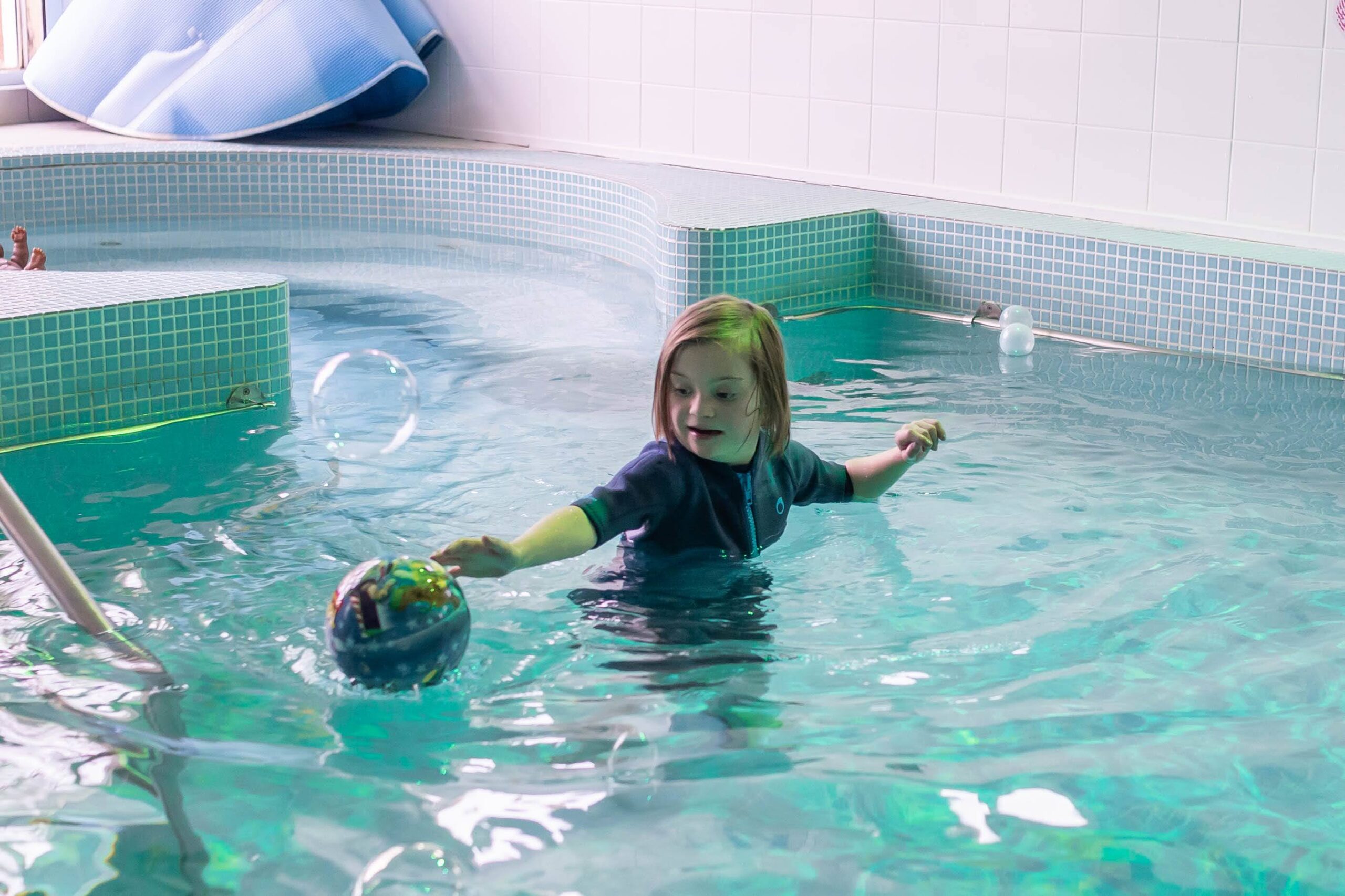
“Soph loves being in the water,” Ellen says. “If we’re ever at the beach, the first thing she tries to do is to run off into the sea to find Maui but then run straight back out again when she realises how absolutely freezing cold it is.”
Because of Sophie’s condition, swimming isn’t straightforward.
“With Soph’s condition, it means her circulation is very poor. Her oxygen levels are always very low, so we can’t use public swimming pools,” Ellen explains. “We can’t use anything like that because she will literally turn blue and the circulation will get worse and worse.”
That’s why being able to use the pool at Shooting Star House meant so much, not just for Soph, but for the whole family.
“When we were invited to use the pool, it was just brilliant,” Ellen recalls. “I had a three-year old and a newborn. It was my son’s first ever swim here in the pool at Shooting Star House.” Ellen continues. “That might sound like not much, but when it’s difficult to do typical things together as a family, having that opportunity was really special.”
For many families, swimming together is something easily taken for granted. For Soph’s family, it was something they simply couldn’t access.
“She gets tired very easily. We use a wheelchair as sometimes just walking around the supermarket because it gets too much,” Ellen explains. In the water, however, Soph can move more freely, supported by specialist physiotherapists who make every session engaging and tailored to her needs and playing a vital role in her health and wellbeing
“They just make it wonderful. They make it fun. She’s exercising without realising it,” “Everything is focused on Soph and that is so important holistically, physically and for her confidence as well.” The environment itself is just as important. Soph has sensory processing difficulties, meaning busy, noisy environments can be overwhelming, even physically painful.
“Places like general swimming pools are a no go for her,” Ellen explains. But the pool at Shooting Star House is designed around children like Soph.
“It has the extra elements like the lights and the music, but she’s in control of them,” Ellen says. “So, she can say ‘music now please’ or ‘lights off please’. We know that she feels safe and confident in this pool because she doesn’t even have her ear defenders on in there,” Ellen says.
But recently, that sense of routine and familiarity has been disrupted. With the pool out of action, the impact on Soph and her family has been significant.
“It might be a way that people don’t actually think of, but using the same space every two weeks with the same people is really, really important,” Ellen says. “To suddenly not have that anymore, we do really miss it.”
Soph relies on structure to understand her day. At home, she uses a visual timetable and her favourite visual symbol is the picture of the pool. “That has genuinely been like a real impact on us,” she explains. “It’s hard when things change to have that consistency and continuity… it’s golden. It’s really important.”
The family have tried alternative pools, but nothing compares. Either the environment, the facilities, or the distance makes them unsuitable.
“There isn’t, as far as I know, anything nearby that suits our need at all,” Ellen says. “A typical child can access lots of different things, when you have a child with a life-limiting condition and neurodiversity, your options become very narrowed very quickly.
“Honestly, there’s nothing like it that we can just rock up to with no issues, no worries,” Ellen says.
“Although it’s a pool, it’s part of something much bigger,” Ellen says. “It just makes for a really whole experience rather than just a hydrotherapy experience.”
Now, with the pool out of action, the family feel that loss deeply and hope it can be restored.
“The pool is just wonderful in all different ways,” Ellen says. “There’s nothing like it.”